The sexual wellness category is seeing increased interest in botanical ingredients, with retailers focusing on traditional uses and emerging research to inform customer discussions. Susan Bratton, an intimacy expert, highlighted the importance of distinguishing between libido, desire, and arousal when discussing these products.
Understanding Botanical Sexual Wellness
Botanicals found in modern sexual wellness products have long histories of traditional use across various cultures. Examples include maca root in the Andes, tongkat ali root in Southeast Asia, and plants incorporated into traditional health, vitality, and intimacy practices for generations. Researchers are currently studying many of these ingredients to understand their potential effects and mechanisms.
For retailers, understanding both traditional uses and emerging research provides context for discussions with customers about botanical sexual wellness products. Consumers are increasingly interested in knowing not only what is in a product but also why it is included.
Distinguishing Libido, Desire, and Arousal
Consumers often view "sex drive" as a single concept, potentially lacking the vocabulary to differentiate between wanting more pleasure and feeling more pleasure. Susan Bratton divides sexual vitality into three interconnected areas: libido, desire, and arousal.
- Libido: This is described as the physical baseline. Overall health and hormonal changes can influence libido.
- Desire: This represents the psychological and emotional component. Desire can be responsive, emerging after connection or stimulation, rather than spontaneous. Stress, depression, anxiety, and body image can also influence desire.
- Arousal: This refers to the body’s physiological response leading up to and during intimacy, involving processes such as increased genital blood flow. Relaxation can also play a role in the body’s sexual response.
Understanding these distinctions allows retailers to move beyond vague promises of "better sex" and instead understand the specific experience a customer seeks. This framework can guide discussions about ingredients and formulations, making conversations more specific.
From Traditional Use to Modern Research
Several botanicals commonly found in sexual wellness supplements have both historical use and modern research attention:
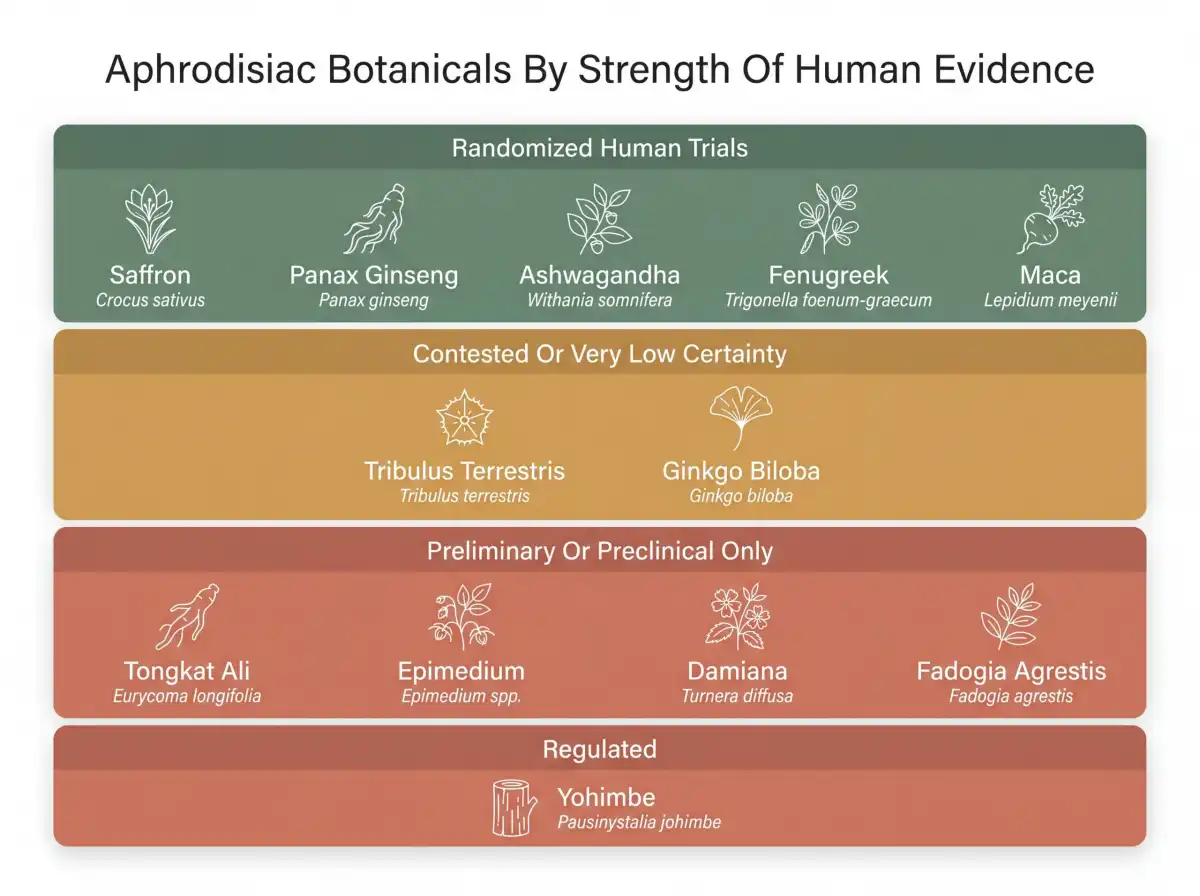
- Maca (Lepidium meyenii): Cultivated in the Peruvian Andes, maca has a history as a food and a traditional source of stamina and vitality. It is studied for its potential relationship to sexual desire and well-being. A 12-week randomized trial in healthy men found gelatinized maca improved self-reported sexual desire from week 8, with no change in testosterone. A 2008 dose-finding pilot in 20 outpatients with SSRI-related sexual side effects found benefit at 3 grams per day of maca, and no benefit at 1.5 grams per day. A 2010 systematic review by Shin and colleagues found 4 randomized trials of maca and called the evidence limited, with more rigorous studies needed.
- Tongkat ali (longjack): Originating in Southeast Asia, particularly Malaysia and Indonesia, its root has a long history of traditional use. Researchers have studied tongkat ali for potential effects on stress, hormones, and sexual health.
- Fenugreek: With a long history in Ayurvedic and other traditional practices, its seeds have been used in foods and herbal preparations. Extracts appear in supplements marketed for sexual wellness, and some research has examined fenugreek’s potential relationship to sexual desire and hormonal health. Fenugreek carries a strong trial record.
- Cacao: Mesoamerican cultures consumed cacao in ceremonial and culinary preparations. Cacao contains polyphenols studied for their relationship to cardiovascular function and nitric oxide pathways, appearing in products marketed for sexual wellness and circulation. Raw Peruvian cacao is stocked by Azarius.
- Ashwagandha: Used in Ayurvedic traditions for centuries and described as an adaptogen. Its potential effects on stress and well-being make it an ingredient in sexual wellness formulations, as stress can interfere with sexual interest and response. Ashwagandha carries a strong trial record. A 2015 pilot study randomized 50 healthy women to a high-concentration ashwagandha root extract, 300 milligrams twice daily for 8 weeks, against placebo.
- CBD: A more recent addition to the modern sexual wellness category, though hemp has a longer history. Interest in CBD focuses on the endocannabinoid system and its potential relationship to relaxation and stress. A 2019 survey of people who used cannabis with sex found 58.9% reported increased desire for sex and 73.8% reported increased sexual satisfaction.
- Damiana (Turnera diffusa): Native to Mexico, Central America, and the American Southwest, damiana leaves have traditionally been brewed as tea, infused into alcohol, and incorporated into herbal preparations associated with desire and sensuality. Mexican folk herbalism gave damiana a reputation as an herb for lovers, historically associated with desire in both sexes. Damiana has preclinical data only. Azarius stocks damiana leaves and damiana 10x extract.
- Saffron: Saffron carries a strong trial record.
- Panax Ginseng: Panax ginseng carries a strong trial record.
- Tribulus Terrestris: A review of eleven Tribulus terrestris studies exists. Tribulus Terrestris has preclinical data only.
- Ginkgo Biloba: Ginkgo Biloba is among the best-studied botanicals.
- Epimedium: Epimedium has preclinical data only.
- Fadogia agrestis: Fadogia agrestis has preclinical data only.
Traditional use and modern scientific evidence are distinct. A long history of use provides cultural context, while clinical research clarifies evidence for a specific ingredient, dosage, or outcome.
Building Trust Through Education
When customers choose a product, they are also deciding whether to trust the product and the retailer. Education is important in a category where customers may recognize ingredients but not fully understand them. Retailers can explain why an ingredient is included in a formulation, discuss its traditional use, and direct customers to product information, rather than promising specific outcomes.
Listening to customer descriptions is also important. A customer seeking help with low energy may have different needs than one concerned with stress, relaxation, physical arousal, or sensation. Understanding these distinctions helps retailers navigate the category without reducing every conversation to a generic "libido booster." This approach also allows for more thoughtful merchandising of sexual wellness supplements, organizing products by customer goals such as vitality, mood, relaxation, or arousal, rather than simply grouping all botanical formulas together.
The botanical sexual wellness category combines tradition, consumer curiosity, and modern research. Retailers who understand the distinctions among libido, desire, and arousal, and the intended role of individual ingredients, are better equipped to answer customer questions and provide information for informed decisions.
Key Facts
- Susan Bratton, an intimacy expert, published an article on November 23, 2026, discussing traditional aphrodisiac botanicals for retailers.
- Bratton identifies libido, desire, and arousal as three distinct components of sexual vitality.
- Botanicals like maca, tongkat ali, fenugreek, cacao, and ashwagandha have long histories of traditional use and are now subjects of modern research.
- CBD is a newer ingredient in sexual wellness, with interest in its potential relationship to relaxation and stress.
- Retailers are advised to distinguish between traditional use and modern scientific evidence when discussing products.
- Maca, saffron, Panax ginseng, ashwagandha, and fenugreek carry the strongest trial records among plants sold as aphrodisiacs.