The adult industry is facing calls to address sizing discrepancies in pleasure products and apparel, with industry figures highlighting the commercial benefits of improved size inclusivity. Accurate sizing is identified as a key factor in customer satisfaction, reduced returns, and increased brand loyalty.
Addressing Sizing Gaps in the Adult Industry
Mersy Love, co-owner and co-founder of Bodacious Afterhours, a sexual wellness boutique, has emphasized the need for the sexual health industry to improve sizing, particularly for plus-size clothing, lingerie, and kink accessories. Love, who has experience in the industry from a young age, noted a consistent lack of proper plus-size options, a sentiment she reports hearing from both shop owners and clientele.
Love challenges the notion that there is no market for plus-size options, stating that this perspective does not align with customer experiences. She points to a discrepancy between industry assumptions and consumer demand, despite statistics on average U.S. body size over the past 20 years suggesting clothing sizes generally fall between M-XL. However, Love highlights that separate estimates of plus-size consumers suggest a potentially substantial market, raising questions about the availability of products to match this demand.
Companies currently offering plus sizes up to 4XL-6XL are reportedly not seeing the expected sales, with reasons cited including insufficient sales to make it feasible, retailers not selling enough plus-size pieces, or stock sitting in warehouses. Love suggests this indicates a hurdle related to size and measurement grading.
Love explains that plus-size clothing requires more than simply scaling up existing designs. Specific considerations include wider straps for full-bust support, wires larger than a D cup, support mesh in the torso, and widening the gusset to accommodate variations in body tissue and genital size. Examples of brands addressing these needs include Parfait Lingerie's Mia group, which offers a regular range (XS-3XL) and a plus version (XS+-3XL+) with larger cups and support, and Curvy Kate Lingerie's Suspense bodysuit, available up to 30DD-42J.
Fit Fully Yours, a Canadian bra brand, is cited for its success in fitting bras up to 46J/40L/36M and underwear up to 5XL. Anna Gladysz from Fit Fully Yours noted an increase in sales and better reviews after sending samples to boutiques like Bodacious Bustlines in Saskatoon to gather feedback and confirm fits on customers. This approach has been described as invaluable, especially given that lingerie cannot simply be scaled up.
Beyond apparel, Love also calls for kink and sexual accessory companies to improve sizing. She notes ongoing issues with body harnesses, strap-on harnesses, and panty vibrators that do not fit customers, stressing that all body sizes deserve options that enhance pleasure and sexuality.
Commercial Impact of Accurate Sizing
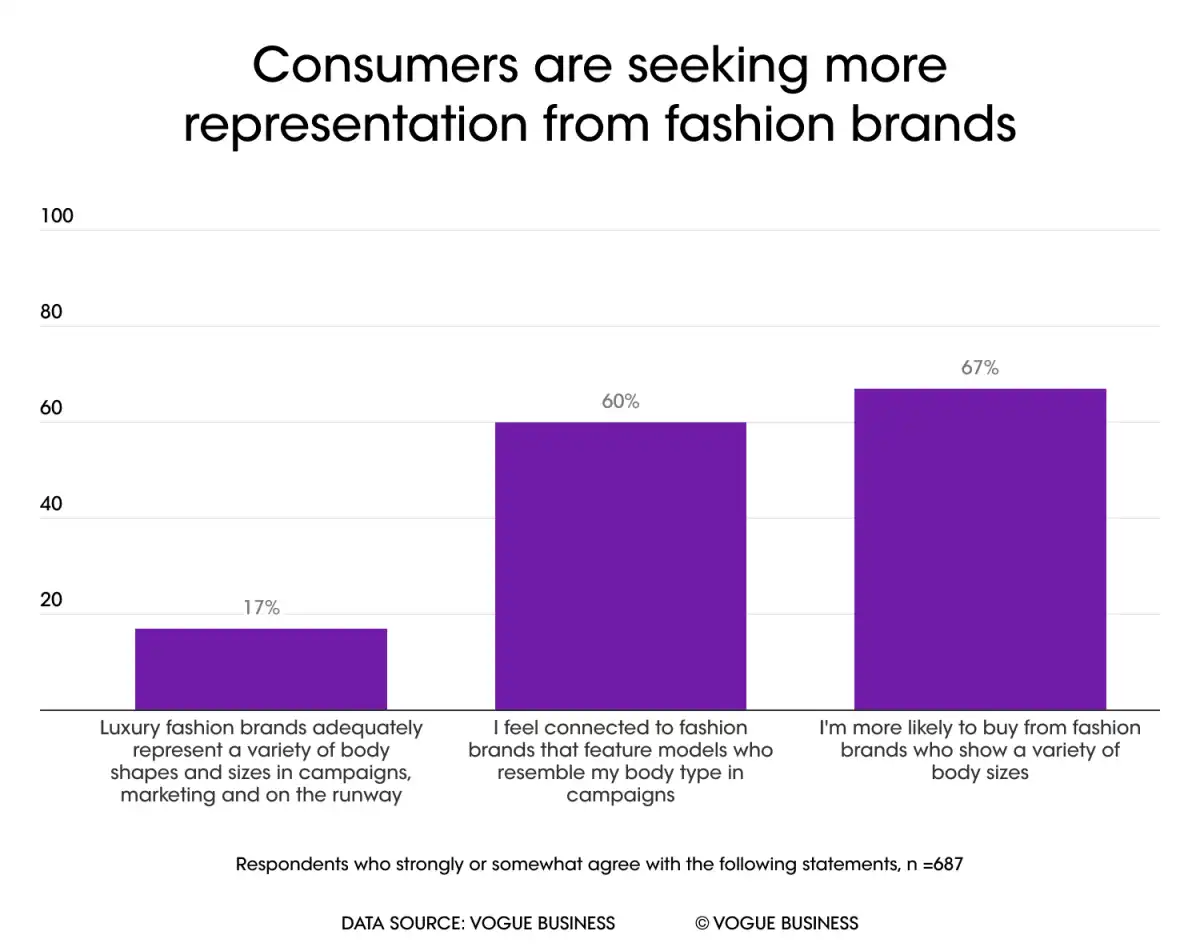
The broader retail industry recognizes accurate sizing as a commercial lever that can reduce returns, boost loyalty, and protect margins. Research from Vogue Business indicates that poor fit (43%) and inconsistent sizing (36%) are significant deterrents to purchasing fashion items, second only to cost (50%) and quality (50%). A survey of Vogue, Vogue Business, and GQ readers in the US and UK found that 51% were mid-sized (US 6-12), 25% were plus-sized (US 14+), and 18% were straight-sized (US 0-4).
Many consumers, particularly mid and plus-sized individuals, report feeling alienated by fashion brands due to inconsistent sizing, poor availability, and a lack of representation. This not only creates practical barriers to purchase but also has an emotional impact, limiting loyalty. Approximately half (48%) of survey respondents reported feeling "pre-alienated" by brands due to sizing issues.
Inaccurate sizing is identified as a "silent profit killer" for clothing businesses, especially e-commerce stores, leading to returns, disappointed customers, and lost revenue. In the UK, around 30% of online fashion purchases are returned annually, with poor fit being the primary reason. This issue is more prevalent among women, with nearly 13% citing poor fit as a regular reason for returns, compared to 7% of men. The practice of "bracketing," where 62% of shoppers order multiple sizes with the intent to keep one, further contributes to reverse-logistics costs that can erode profit margins.
Recommendations for Industry Improvement
Love encourages companies to engage directly with customers and retailers to understand their needs. She suggests designers involve people of all sizes in item mock-ups, measure and check fits before production, and utilize retailers to fit samples on everyday customers. The consistent presence of limited XL+ options in thrift stores also raises questions about access to quality extended-size clothing, even in the secondhand market.
The industry is urged to move beyond promises of "working on it" and "being patient" to actively produce well-made, proper plus-size options. This approach is seen as crucial for supporting a significant portion of the customer base.
Key Facts
- Mersy Love, co-owner of Bodacious Afterhours, highlights a consistent lack of proper plus-size options in the sexual health industry.
- Poor fit (43%) and inconsistent sizing (36%) are major deterrents to purchasing fashion items, according to Vogue Business research.
- Approximately 30% of online fashion purchases in the UK are returned annually, with poor fit being the leading cause.
- Plus-size clothing requires specific design considerations beyond simply scaling up, such as wider straps, larger cup wires, and support mesh.
- Brands like Parfait Lingerie, Curvy Kate Lingerie, and Fit Fully Yours offer extended sizing with specialized design features.
- Direct customer feedback and fitting samples on diverse body types have led to increased sales and better reviews for companies like Fit Fully Yours.